
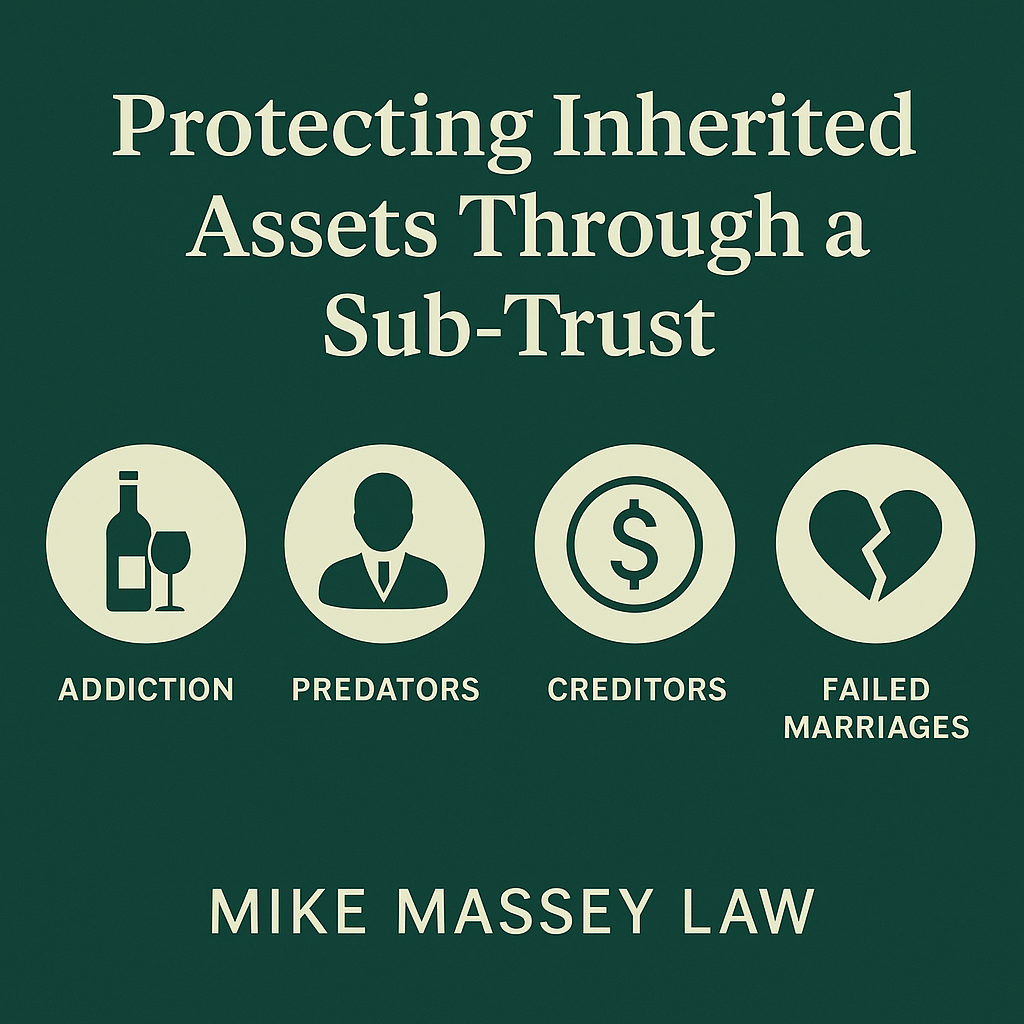
The Importance of Protecting Inherited Assets Through a Sub-Trust
By Mike Massey Law — Texas TRUST AND ESTATE PLANNING ATTORNEYS
Introduction: A Common Oversight in Estate Planning
Many parents and grandparents work hard to leave behind a meaningful legacy — a home, savings, or investments intended to give their loved ones security and opportunity. Yet, one of the most common mistakes in estate planning is leaving those assets outright to beneficiaries.
When inherited assets go directly to a beneficiary’s name, they can be immediately exposed to life’s risks: creditors, divorce, lawsuits, addiction, or financial mismanagement. Fortunately, there’s a powerful legal tool that can protect your legacy — the sub-trust, sometimes called a “beneficiary-controlled trust” or “inherited asset protection trust.”
What Is a Sub-Trust?
A sub-trust is a trust created within your revocable living trust that takes effect upon your passing. Instead of distributing assets directly to your beneficiary (like your child), the assets stay in the sub-trust for that beneficiary’s benefit.
This means your loved one can still benefit from the assets — they can use the funds for health, education, housing, and other approved purposes — but the money is legally insulated from outside threats.
It’s one of the most effective ways to ensure that what you leave behind is used for your loved one’s long-term security, not lost to an unexpected problem.
Why Inherited Assets Are Vulnerable Without a Sub-Trust
Here are the main threats to inherited wealth when assets are distributed outright:
1. Addiction or Poor Spending Habits
If a beneficiary struggles with addiction or impulsive financial behavior, an outright inheritance can do more harm than good. A sub-trust allows you to control distributions, often through a trusted trustee or set of clear rules, so funds can be used responsibly and sustainably.
2. Predators and Opportunists
Sadly, sudden inheritances can attract unwanted attention. Unscrupulous friends, romantic partners, or even caregivers can pressure or manipulate a beneficiary. With a sub-trust, assets remain protected — the trust, not the beneficiary, legally owns the funds, making them harder for bad actors to access.
3. Creditors and Lawsuits
If your beneficiary ever faces a lawsuit, bankruptcy, or business failure, an outright inheritance can be seized by creditors. A properly structured sub-trust acts as a legal shield, keeping assets out of reach of most creditors.
4. Divorce or Failed Marriages
Inheritance is often intended to stay within the family — but if your child later divorces, their inheritance can be divided or claimed by an ex-spouse. A sub-trust preserves the assets as separate property, helping ensure your legacy stays with your bloodline.
Under Texas Family Code § 3.001, property a person inherits is classified as their separate property by law — not something a divorcing spouse is automatically entitled to a share of. The real risk isn’t the inheritance itself; it’s what happens to it afterward. Deposit it into a joint account, use it to improve community-property real estate, or otherwise mix it with marital funds, and it can lose that separate-property protection in a divorce. A sub-trust sidesteps this risk entirely — the inheritance is never titled in the beneficiary’s individual name or a joint account in the first place, so there’s nothing to commingle.
The Protective Power of a Sub-Trust
A well-drafted sub-trust can provide several key benefits:
- Long-term protection: The assets remain protected for the beneficiary’s lifetime.
- Flexible access: The trustee can make distributions as needed, and in some cases, the beneficiary can even serve as co-trustee under certain safeguards.
- Preserves eligibility for benefits: For beneficiaries with disabilities, a sub-trust can be structured to preserve government benefits while still providing financial support.
- Legacy continuity: Upon the beneficiary’s death, remaining assets can pass to your grandchildren — ensuring multi-generational protection.
How Sub-Trusts Fit Into a Comprehensive Estate Plan
At Mike Massey Law, we typically build sub-trusts within a client’s revocable living trust. This allows for smooth administration, privacy, and the ability to adapt to your family’s unique needs.
For example:
- If your daughter is financially savvy and stable, her sub-trust can give her more control.
- If your son struggles with addiction or impulsive spending, his sub-trust can require trustee approval for distributions.
- If a child is married, their sub-trust can ensure inherited funds remain separate and protected from divorce claims.
Every sub-trust is customized — the goal is to balance protection with flexibility.
Hypothetical Example
Imagine a parent leaves $500,000 to their son outright. Within a few years, he divorces, and his ex-spouse claims half of it in the settlement. Or, he faces a business lawsuit, and creditors attach liens to his assets.
Now imagine that same inheritance placed in a sub-trust. The son still benefits from the income and principal as needed — but legally, it’s not his personal property. The assets remain beyond the reach of ex-spouses, creditors, or impulsive decisions.
That’s the difference between hoping your legacy lasts and ensuring it does.
FAQs
Q: Is an inheritance automatically protected from my spouse in a Texas divorce?
A: Yes, under Texas Family Code § 3.001, inherited property is classified as separate property by default. That protection can be lost if the inheritance gets commingled with community assets — deposited into a joint account, for example, or used to pay down a shared mortgage. A sub-trust prevents commingling by design, since the inheritance never passes directly into the beneficiary’s name.
Q: Can my beneficiary still use the money for everyday needs if it’s held in a sub-trust?
A: Yes. A properly drafted sub-trust still allows distributions for things like health, education, and housing — the beneficiary isn’t locked out of the funds. They’re simply held in a protective structure rather than titled directly in the beneficiary’s own name.
Q: Does a sub-trust protect against creditors, not just divorce?
A: Yes — that’s covered in the “Creditors and Lawsuits” section above. Because the sub-trust holds legal title rather than the beneficiary personally, outside creditors generally can’t force distributions or attach the trust principal directly.
Conclusion: Protecting Your Legacy the Smart Way
You’ve worked hard to build something worth leaving behind. But true legacy planning is about more than passing wealth — it’s about protecting your loved ones from life’s uncertainties.
A sub-trust gives you peace of mind that your beneficiaries will be supported — not exposed — after you’re gone.
At Mike Massey Law, we help Texas families design customized estate plans with built-in asset protection, including sub-trusts that reflect your family’s values, dynamics, and long-term vision.
Ready to Protect Your Family’s Future?
Contact Mike Massey Law today to schedule your free estate planning consultation and learn how sub-trusts can safeguard your legacy.
📞 Call: (512) 407-2407
🌐 Visit: www.MyTXWills.com
About the Attorney: This article is written by Mike Massey, JD, MBA, MPA, founder of Mike Massey Law and a licensed attorney with the State Bar of Texas. Mike Massey Law designs sub-trust structures tailored to each family’s specific risks — financial immaturity, creditor exposure, or marital instability — rather than using one generic template for every beneficiary.
Last Updated: Oct 2026


